
The UAE remains a premier global destination for tourism, career growth, and business. However, if you have recently tried to apply for a visa from certain regions, you may have encountered unexpected roadblocks. Rumors about sweeping nationality bans are circulating widely online, causing significant confusion for travelers and job seekers alike.
While the government has not formally published a press release titled “UAE Visa Ban 2026 Countries,” there are confirmed, strict administrative holds affecting specific nationalities. Whether you are a professional facing a UAE work permit ban or a traveler navigating a UAE tourist visa suspension, understanding the reality of the UAE immigration rules 2026 is critical.
Here is a factual breakdown of which countries are affected, why applications are being held, and what it means for your travel plans.
Which Countries Are Currently Facing Visa Restrictions?
Based on consistent reports from immigration consultancies, embassies, and recent applicant experiences, the UAE has temporarily paused the processing of new tourist and work visas for citizens of nine specific countries.
If you hold a passport from one of the following nations, you are currently highly likely to face processing freezes or automatic rejections for new applications:
| Country | Current Visa Status (2026) | Primary Context |
| Afghanistan | Processing suspended | Long-standing security screening protocols |
| Bangladesh | Under processing hold | Large migrant population; ongoing digital system reforms |
| Cameroon | High refusal rate | Active suspension for new tourist and employment applications |
| Lebanon | Processing suspended | Tied to regional instability and diplomatic complexities |
| Libya | Processing suspended | Formalized processing suspension for new applicants |
| Somalia | High refusal rate | Strict security screening and compliance checks |
| Sudan | Complete application freeze | Ongoing regional instability and conflict |
| Uganda | Complete application freeze | Suspensions heavily impacting new work permit requests |
| Yemen | Processing suspended | Continuation of restrictions from previous years |
Key insight: These restrictions target new applicants. If you are a citizen of one of the UAE visa ban 2026 countries but are already legally residing in the Emirates with a valid visa, you are largely unaffected and can continue to live and work normally.
Why is the UAE Restricting Visas?
The UAE’s immigration framework is dynamic and heavily data-driven. The latest UAE visa ban countries 2026 update is not arbitrary; it stems from a combination of national security protocols and systemic upgrades:
- Security & Compliance: The primary driver is national security. The UAE rigorously screens to prevent document fraud, unlawful migration, and identity theft.
- Diplomatic and Regional Factors: Visa policies frequently act as a barometer for international relations. Regional instability or strained diplomatic ties can lead to temporary visa pauses for affected populations.
- Digital Immigration Reform: The UAE is actively digitizing its verification systems to streamline processing and eliminate fraud. During this transition, applications from regions with historically higher rates of documentation inconsistencies are often paused.
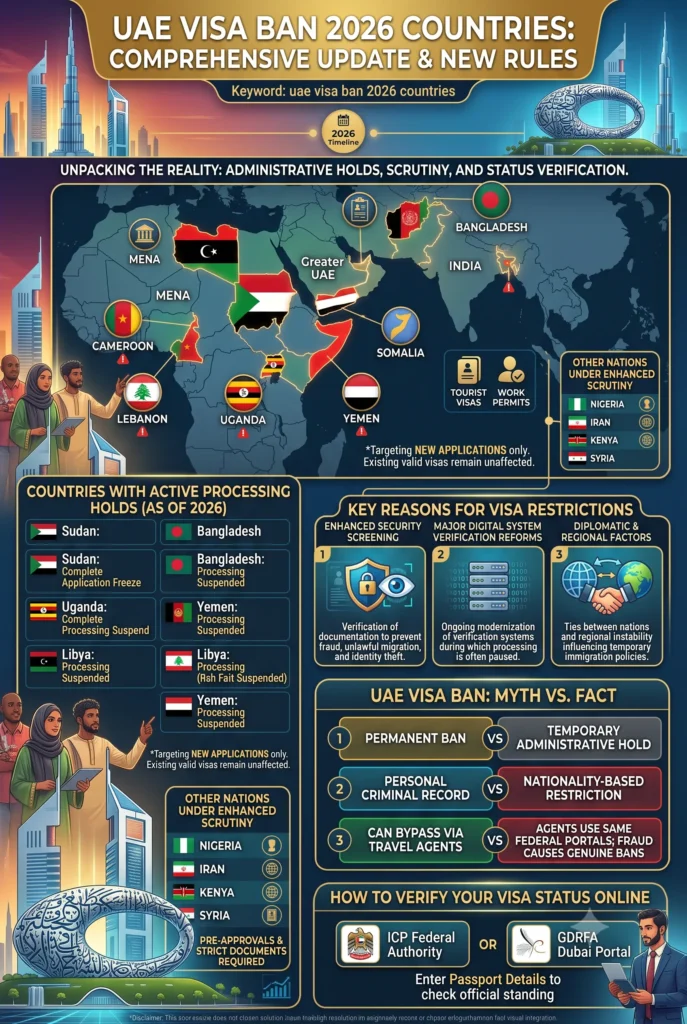
Other Nationalities Facing Enhanced Scrutiny
Beyond the nine heavily restricted nations, several other blocked nationalities UAE searches refer to countries that aren’t fully banned but are subject to strict pre-approvals.
Citizens from countries such as Nigeria, Iran, Kenya, and Syria may find their applications require additional screening, mandatory eye scans, or proof of prior UAE residency. For these applicants, avoiding a UAE visa rejected status relies heavily on the credibility of their sponsor, impeccable documentation, and strict adherence to specific visa category rules.
Myth vs. Fact: Understanding the Reality
With so much speculation online, it is easy to misinterpret immigration policies.
- Myth: “The UAE has permanently banned these nationalities.”Fact: These processing holds are temporary and administrative. They are periodically reviewed by UAE authorities without prior notice.
- Myth: “If my application is rejected, I have a personal criminal ban.”Fact: A nationality-level restriction is entirely separate from a personal ban. A rejection based on your passport does not mean you have a personal police record in the UAE.
- Myth: “A good travel agent can bypass the ban.”Fact: All authorized agents submit applications through the same official government portals. Unscrupulous agents claiming they can bypass federal restrictions often submit fraudulent data, which can result in a genuine, long-term personal ban.
How to Check Your Visa Status
If you are unsure where you stand—especially if you suspect you might have an individual restriction due to a past overstay or financial dispute—you should verify your status directly through official channels.
If you are wondering how to check UAE visa ban status, you can do so online via the ICP (Federal Authority for Identity, Citizenship, Customs & Port Security) or the GDRFA (General Directorate of Residency and Foreigners Affairs) portals. By entering your passport details, you can view your official immigration standing; a “File Blocked” notification typically indicates an active administrative or judicial restriction.